Eat For You Dietitian

Specialist Dietitian in Eating Disorders and Disordered Eating

HCPC Registered
  • I have been a registered dietitian for almost a year working within the community setting. When I tell people this some look at me with a confused look. Working as a dietitian in community I am involved with primarily people who are unable to leave their homes for a variety of medical reasons, elderly population in care homes and undertaking one-to-one clinic consultation sessions a couple times a week.

    As a dietitian I am trained to treat a range of medical conditions with dietary therapy, specially tailored to each individual, which is one aspect of one-to-one clinic consultations and the other part is advising on healthy eating by translating nutrition science into practical information allowing people to make informed lifestyle and food choices.

    One of the most common piece of advice I am giving is to stop overcomplicating eating and to actually start eating regularly. I have lost count of how many people have said they are trying to lose weight so they are eating 1 meal a day, counting exactly 1200 calories a day, even counting the number of blueberries they’re having and can’t understand why they’re not losing weight. More often than not they are snacking regularly without realising or managing on 1 meal a day with severely low energy which they will then supplement with copious amounts of caffeine. 

    Here comes the dietitian who says can you please start eating 3 balanced meals a day, can you please hydrate yourself with 2 litres of water a day, and can we talk about methods to improve your sleep. This doesn’t mean you have to spend loads of money on buying organic, having full bowls of beans (if you’ve never had beans before please don’t do this), kale, quinoa, chia seeds, spirulina or any gadgets. This means beginning simply by shaping your meals to include a source of carbohydrates (preferably wholegrain), protein, and vegetables in their main meals.

    Falafel and halloumi wraps with veggies and salad

    Crispy chilli tofu with mushrooms served with basmati rice and spring onions

    The reason I advise 3 regular meals a day to shape breakfast, lunch and dinner is to ensure they are fuelling our bodies regularly. Usually the response I get is that don’t I have to eat less in order to lose weight. The common misconception is that they only need to increase protein to build muscle when there is much more to it then that. Any bodybuilder is able to tell you that.

    The information I translate to individuals is primarily around food as I am the dietitian and I ensure to work within my scope of practice, however ‘how we nourish our bodies’ is only one factor. Stress, sleep, movement, hydration, smoking and alcohol, genetic predispositions and other environmental factors that also play a big part in how we do that. Therefore during my consultations I find that these factors are what the individual needs to improve to them in turn change how they are nourishing their bodies.

    How can we create positive views around food?

    My tips:

    • Get rid of the numbers – stop counting calories, checking your weight daily/weekly unless medically necessary, stop weighing your portion sizes
    • Choose a wholegrain carbohydrate most of the time
    • Choose various sources of protein
    • More colour on the plate
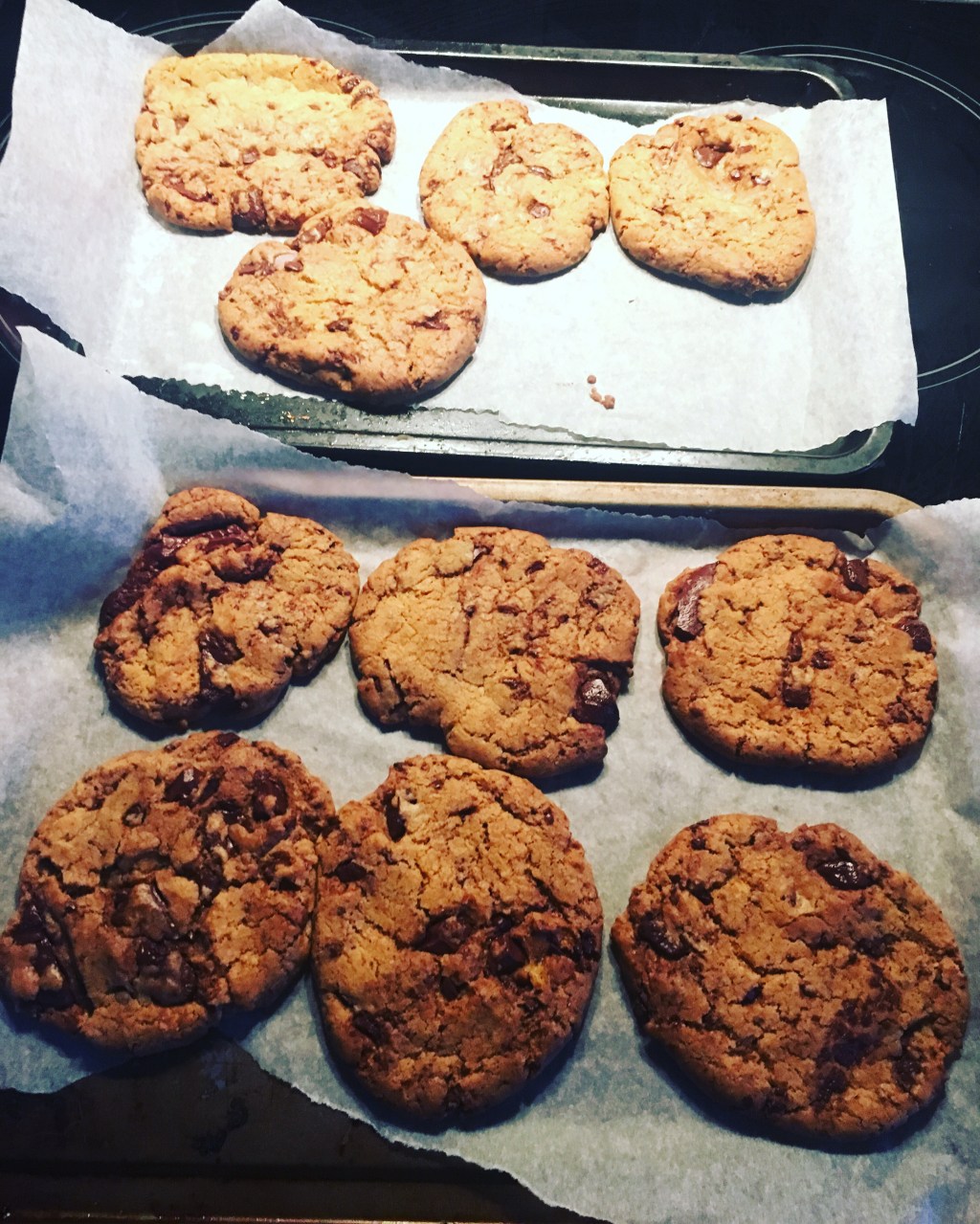
    • Never say no to cake or cookies just because you’re being ‘good’ or ‘healthy’ today or ‘oh that’s naughty’
    • You can have your cake and it eat too
  • IBS Awareness Month

    A large proportion of what I come across as a Registered Dietitian in outpatient clinics is due to IBS-related symptoms. There can be whole clinics which almost every client can be experiencing some type of IBS symptoms.

    What is IBS and how is it diagnosed?

    IBS is a common condition affecting the gut which is diagnosed by the presence of intermittent stomach pain associated with diarrhoea, constipation, or alternating episodes of both.

    Unfortunately there is no diagnostic test to confirm IBS. The symptoms of IBS are non-specific and tend to vary from person to person, which makes it even harder to diagnose and often the diagnosis slips through the net and many cases go undiagnosed, or what’s more it can be wrongly diagnosed. If you are experiencing any symptoms for longer than 6 months, which is impacting on your daily life activities you should go to your GP to rule out serious gastrointestinal conditions such as coeliac disease or inflammatory disease. Your GP can do this by ordering a blood test and stool sample if required. Remember though, to ensure the test results are accurate for coeliac disease you need to still be eating gluten in your diet regularly.

    Usually when I have a client come into a consultation for the first time the belief is that their diet is the primary cause of their IBS-related symptoms. Dietary triggers vary from person to person, however the main key dietary triggers that be common include caffeine, fizzy drinks, alcohol, spicy food, high fat or fried foods, and poor fluid intake. Usually individuals are not aware of their intake of these types of foods and particularly how much water they drink until they have to write it down on paper.

    Other triggers I also try to identify is when did all these symptoms begin. Was there something that caused a huge amount of stress and ongoing stress? What I commonly find out is that a big life event (usually negative) occurred such as bereavement, accident, starting a new job or starting university or an illness such as travellers diarrhoea, gastroenteritis, food poisoning or taking several courses of antibiotics for a variety of reasons. Can you identify an event like one of these that may have triggered the onset of your IBS-related symptoms?

    I think Runners/Athletes can relate stress to negative gut symptoms very much. Anyone who has ever been nervous before a 5k, 10k, half marathon, marathon or other endurance event will have experienced running to the loo several times before the start. If you keep on going then pretty soon you finds ways to manage your nerves and get your pre-race routine down to a T.

    1 in 5 people in the UK at some point in their lives will be affected by IBS and it affects twice as many women as men. Key points to remember is to not focus all your changes on your diet and begin excluding foods unnecessarily. If we are stressed and anxious prior to eating bread or pasta and then after finishing to eat we feel symptoms then this might make us feel like its the wheat or gluten that have caused it.

    Real-life story: 

    This week I had a lovely 80 year old lady attend clinic with her husband who was experiencing severe abdominal pains interrupting her sleep, with no change in her bowel movements. She had a major gastrointestinal surgery 7 years ago and recent investigations have not identified any clinical cause for her symptoms. So I asked the question, when did these symptoms begin? And that’s when it was identified, they started approximately 18 months ago following a significant event to a close family member that has led to significant changes to her and her family’s life. She was crying as she explained this to me and I almost followed her with her tears. She is under an enormous amount of stress which alongside severe abdominal pains she has lost a significant amount of weight. When I explained the link between stress levels, and the connection between our brain and gut, I could see a light bulb moment go off. Overall, her daily diet she described is varied and balanced and she has been restricting herself of favourite snacks and puddings that she will watch her husband have instead. Towards the end of the consultation she was extremely happy to have the dietitian say she could eat peanut butter and ice creams her husband keeps in the freezer (alongside other specific dietetic advice) to promote gradual weight gain. Regarding stress management, this is not my area of expertise so I have to make sure I provide information regarding healthcare professionals that can assist and trying methods to relieve stress management – such as breathing exercises, taking time to do something you enjoy independently like reading, or listening to music. 

  • As we’re coming towards the end of February – the year is flying past with mixed weather but I think we’re all in agreement to enjoy the sunshine whilst in lasts.

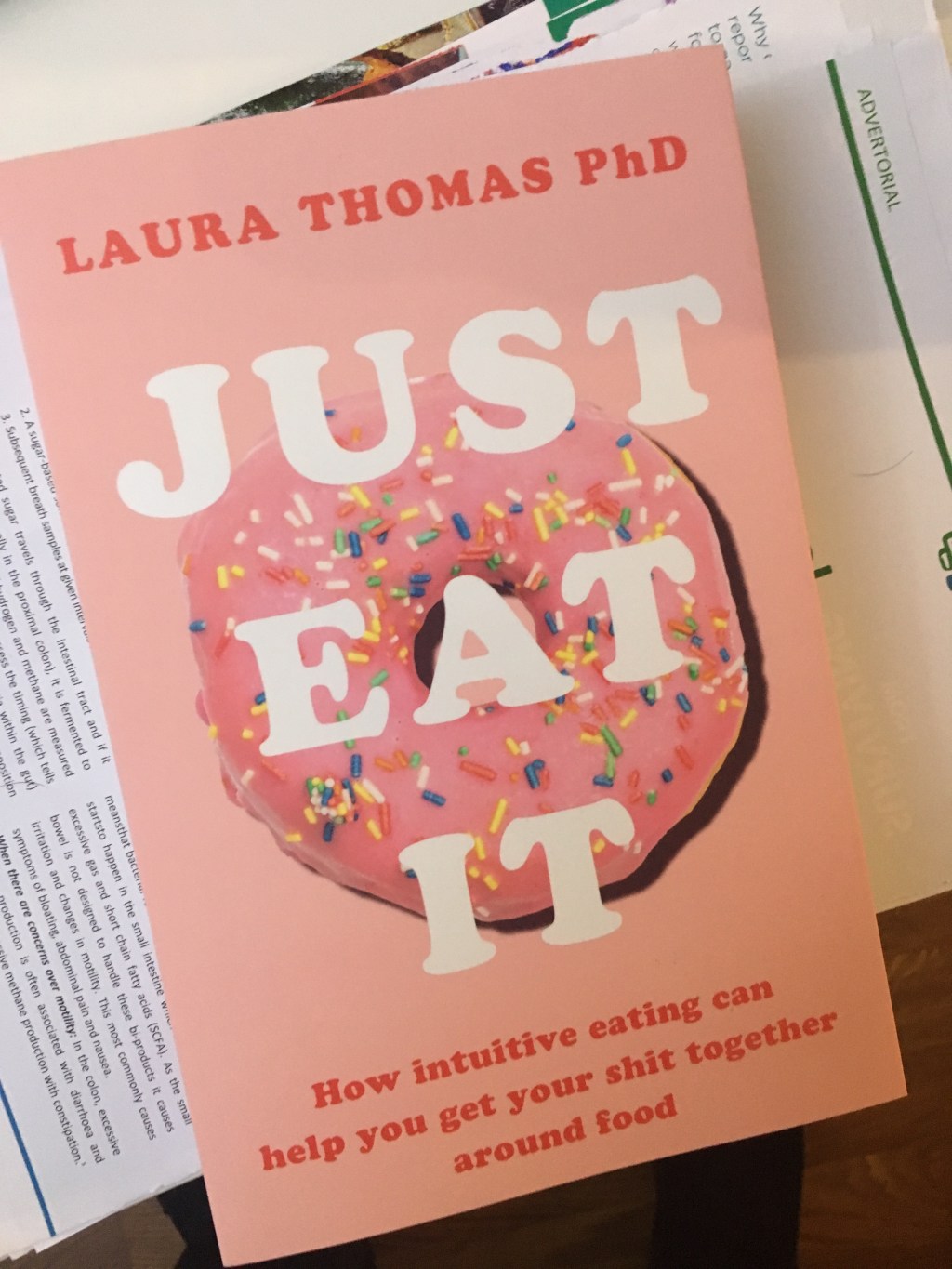
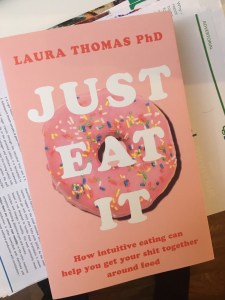
    I’m evaluating what I’ve achieved so far – professionally my dietetic practice has been re-shifted since undertaking the online course of Applying Intuitive Eating in Practice and making my way through the Just Eat It book by Laura Thomas PhD. The crazy thing is, is that it all makes perfect sense. The amount of evidence-based information on weight management studies proving that our NHS based weight management programmes and also paid programmes don’t work and lead to weight cycling all suggests that we are missing a key ingredient. Why do we need food plans to tell us what to eat, our bodies can guide us if we just listen. As I am in the early stages of my learning and whilst working in the NHS it is hard to put these principles into practice, however feedbacking to my colleagues I think we are all in agreement that for most of our weight management patients this approach is the way to go.

    Looking back on my SMART goals achieved in January 2019 and still going strong now …

    • Completed the 30-day Fiit Challenge – includes 4 x 25 minute classes per week – Since finishing this I’ve continue with regular yoga workouts, cardio and resistance band workouts x 3-4 per week
    • Stop having lunch whilst working and keep up with my reading – this can’t be achieved every day but at least twice a week makes such a difference to my day and stress levels. HIGHLY RECOMMENDED.
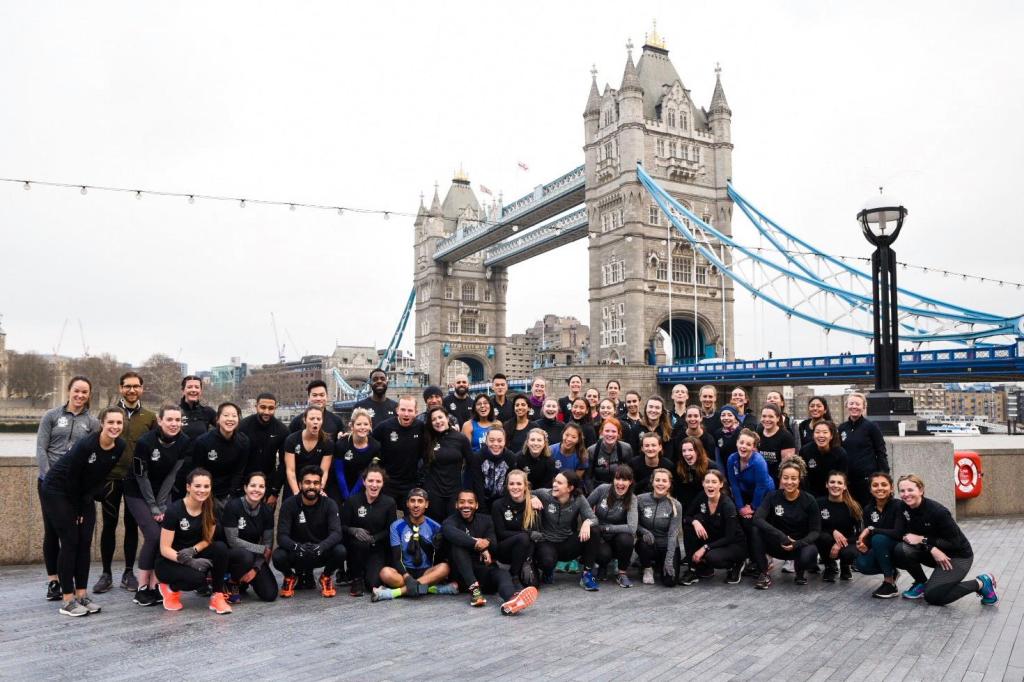
    • Long runs with LDN BRUNCH CLUB. Running motivation followed by my favourite meal of the day – BRUNCH. Being a member of a running club brings different experiences – firstly it’s good to know I can keep a conversation whilst running a good pace, commitment to the events and meeting people going through the same training journey as my usual friends don’t run at all
    49721855_10100600305981032_3198993561634734080_o
    Sunday service resumes after the festive break, with the start of the New Year and our new season. 📷 @annarachphotography. #LDNBrunchClub #SundayLongRun #RunLondon #WeWill #LondonRunning #London #RunningCulture
    • Early morning runs before work per whilst listening to my favourite podcasts – Power Hour, A Happy Place, Don’t Salt My Game, Well Far, Running For Real, Katie Piper’s Extraordinary People, The Food Medic and The Doctor’s Kitchen. This is especially important as then I make sure I get the miles in first thing and I’ve found by the end of my working day I’ve forgotten that I did my run already.

    Also in February, personal goals:

    • 2 Personal bests achieved in running – 10k run at 57mins and Half marathon at 2hr02mins. I can’t wait to attempt a sub-2 half marathon at The Vitality Big Half on 10th March
    • Signing up to new activities to meet new people – book club, Twice The Health group long runs starting in a few weeks
    • Finally taking the leep and seeing a physio to make sure I stay injury free in my marathon training
    • Keep the first hour and last hour of my day social media free. Although when I lack motivation at 5:30am sometimes I use social media to find that extra bit of motivation. I couldn’t recommend The Power Hour podcast more!

    Is there anything you keep on thinking you want to start or change? Do you say ‘I’ll start next week’?

    I think when we decide we want to start something new, we think we have to do it every day from the get-go and then after a week it becomes tiresome. Starting with 1 or 2 times a week or 5-10 minutes a day is still a step in the right direction. Most importantly make sure its something you enjoy and making you feel better.

    There’s no point saying you’re going to read a book a week if that’s not realistic, maybe going for audio books is better for your schedule. Choose physical activity that you enjoy, not because it’s the trendy workouts. Several reasons why I enjoy running and home workouts to the gym, the primary one is because it works best for me (and my 3 dogs who are my running/workout buddies)

    img_3124


  • Exercising for fun, not to lose weight

    A lot of talk this first month of the year is to go to the gym to lose weight and then you know what it all changes as soon as 1st February hits. Why? Why can’t we enjoy exercise? When I did kickboxing in Cardiff I absolutely loved it, one hard hour a week, sometimes 2 was amazing. Unfortunately London classes are too expensive for me and the one I did try out had a different layout and just didn’t feel the same. Last year I did try the gym but it wasn’t really working for me. So why continue to pay for something you dislike. Then Fiit kept popping up, so I gave it a go and I haven’t looked back. People think that because it’s based on you being able to exercise from anywhere that you need a big space. I live a studio flat – there are no excuses, all you need is a mat, water, towel and your set!

    Possibly one of the only ways I jumped on the ‘new year, new me’ was by starting the new Fiit 30-day training plan and to follow it week by week. One my main goals for January 2019 which I finished this week with 2 back-to-back high intensity 40 minute workouts. For me this was a key achievement as I have never been the type of person to stick to a training plan, even one of the 6 week training plans that Fiit do I gave a go but after week 3 I couldn’t up with it.

    The last 30-days however have been really fun. Different trainers and types of workouts and the best competition sometimes is yourself as on the Fiit app you want to push yourself to see if you could beat her previous score or number of reps. It’s not about losing weight anymore, it’s about feeling well and energised, seeing results in my strength and speed. The human body is capable of more and it’s up to us to how we challenge ourselves.

    img_4426

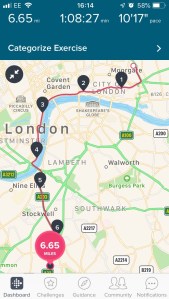
    Even alongside another one of my monthly goals of 4 mile morning runs twice a week before work which Adrienne Herbert is right about from the Power Hour podcast. Making my first hour productive makes that day better from the get go because no matter how your day goes you have already achieved something positive for yourself. My weekends runs are my favourite as it involves community – Parkrun and Ldn Brunch Club which make long runs funner than they’ve ever been. Especially last Sunday when I was so close to bailing but I after I did the first step of getting out of bed I knew I could run and the best thing is I did this long run whilst chatting the whole way.

    img_4421

    These past few days haven’t been great due to icy/snowy pavements in terms of my running mileage but I did complete my Fiit classes so there’s one triumph. I don’t have easy access to a treadmill so instead I have been focusing on recovery and rest before my first race event this weekend. Yoga and stretching have never been such a key part of my training before. If you are still someone who doesn’t stretch after exercising, trust me it works!

    Reshaping my goal for February is:

    • Continue to aim for 2 x 4 mile runs before work – even this means trying out Pay As You Gym to get the miles done on a treadmill
    • Also included in this goal is to achieve 800m in 3.30mins followed by 400m recovery. Aiming for 10 rounds but I’d settle for achieving this once – using the athletics track near work ideally
    • Aiming for my Power Hour every morning before work – whether it’s walking my 3 pups or do yoga
    • Continue to remember that walking every day is still movement for the day and my pups won’t let me get away with that anyways

    Big event this month

    Race swap this month has gone major, from my first half marathon of the year to go from London all the way to Barcelona!! I am lucky enough to have won a free spot for Barcelona Half Marathon next weekend. So my first attempt at achieve over 10 miles this year will be part of an official race. There is no turning back now.

    In terms of my mental health I am continuing to try to have at least 2 days a week away from my desk and computer during my lunch break and reading books one after the other. I am super close to almost finishing the full collection by Jodi Picoult and I am about to start the online course by the London Centre of Intuitive Eating alongside my other 2nd book this month.

    img_4384

    I love this title – Just Eat it. You don’t have to allow yourself, it’s not bad if you eat what you’re not supposed to and it does not undo anything. This point of view is something I have only recently adopted and I look forward to learning the research and background behind this to bring into my dietetic practice. We are surrounded by diet culture and I frequently have to tell individuals I see in clinic that I am not going to prescribe a diet or diet plan, it is a whole healthy and balanced lifestyle. This isn’t only weight management patients I see but especially individuals experiencing exacerbated IBS symptoms. Diet is only one of many components to consider – others include stress, movement, sleep but I find that when I mention these other factors they are regularly disregarded. Most of the time we are looking for the super food or supplement that will make it better. I have learnt over many years that this isn’t the case. Let’s keep our nutrition simple and listen to what our bodies need.


  • Make it stick in 2019 and beyond

    After we indulge in our Christmas festivities with our family and friends the ideas for new years resolutions start coming in. From when I was kid I can remember at least one member of my family would say ‘eat better, lose weight’ or ‘exercise more.’ When I used to go to the gym, in January you would notice a busier atmosphere and everyone energised for getting fitter. At some point in my life I was probably one of those people.

    I recently heard about the third Monday of January (21st January 2019) has been awarded the most depressing day of the year due to a combination of post-Christmas blues, cold dark night, financial issues perhaps and is usually the time that people begin losing motivation to continue their new year’s resolutions.

    Sometimes the reason for this could be that new year’s resolutions are very broad therefore at this time they can seem out of reach and unrealistic so we’d rather go back to are old habits as it’s the easier option. It can appear that way when its reaching almost freezing temperatures and a black sky when we leave for work in the morning and leave work in the afternoon.

    In my experience when I am undertaking a 1-1 clinic consultation with a patient one my key questions in the beginning is ‘what do you want to get out of this consultation?’ The reason for this is because I want the individual I’m working with to identify their own reasons they want to change their diet, whether it’s:

    • Weight loss dietary advice
    • Improve their quality of life that has been disrupted due to IBS-related symptoms
    • Understand how to manage exacerbated symptoms of certain medical conditions

    (to name a very few)

    Specifically for weight loss dietary advice I also ask them to rate their motivation out of 10 (10 being high motivation). Anywhere below 7 I question whether any dietary advice and Specific, Measurable, Achievable, Realistic, Timely (SMART) goals developed together will actually be implemented once they leave the room. So the next step is for them to write down why improving their diet and lifestyle can benefit them.

    This can range from reducing the risk of chronic conditions, improving quality of life to wanting to play with their grandchildren pain free.

    If by 21st January you step on the scales or that piece of clothing doesn’t fit just yet it’s not time to give up but go back to reasons as to why you made the decision in the first place.

    A couple of my SMART goals for January 2019:

    • Complete the 30-day Fiit Challenge – includes 4 x 25 minute classes per week (currently on week 2)
    • Have lunch away from my desk at least twice a week whilst also trying to keep off my phone and read one of my books
    • Complete a long run (at least 10 miles) every 2 weeks in collaboration with my new running club I have joined – LDN BRUNCH CLUB. Running motivation to hopefully help me achieve some Personal Best’s this year followed by my favourite meal of the day.

      49721855_10100600305981032_3198993561634734080_o
      #ldnbrunchclub and credit @annarachphotography
    • Complete 2 x 4 mile morning runs before work per week whilst listening to my favourite podcasts – Power Hour, The Food Medic and The Doctor’s Kitchen img_4269
    Inspiration on social media can be very motivating and it definitely helps me get out of bed at 5:45am for a 4 mile run twice a week since the beginning of the year. Quite honestly it’s the only way I build up my weekly mileage. 
    img_4267

    I haven’t specified any amount of weight loss or what I want to look like. I’m focusing on small goals on a monthly basis and that way I can evaluate if I’ve achieved them and if I haven’t then what’s got in the way perhaps.

    Our dietary habits are one thing but we also need to take care of our mindset and move everyday. Since moving more before work, which does mean sacrificing an hour in bed in the morning (does mean I have to go to bed an hour earlier the night before) I have felt ready to tackle what work brings me in the day. It’s hard to believe at first if you’ve never tried it. I was one of those people that said ‘I can’t wake up early enough to run before work’ and I proved myself wrong.

    img_4268
    First race pack of the year is for 10k Cancer Research Winter Run

    Races of 2019 so far (running can be an expensive sport):

    • Cancer Research 10k Winter Run – February
    • Queen Elizabeth Olympic Park – February
    • The Big Half (thanks to LDN Brunch Club) – March
    • Edinburgh Marathon – May

    I’m choosing to share my journey of a totally unnatural runner trying to push my body to new limits and new personal bests. I am a registered dietitian currently in her first job as a Dietitian in the NHS working in community settings. What you eat and how to change what you eat is a constant topic, I talk about it every day, all day and advice changes depending on the clinical condition and the individual. I enjoy reading new research and evidence-based articles and guidelines. But sometimes when I get home after a long day I don’t always want to continuing reading articles and new research but I am aware there’s a constant influx of research based around sports nutrition. Maintaining a varied, balanced diet and keeping active for me can be a trial and error. There are foods or meals I know are great a few hours or the night before a race event and other foods that do not agree with myself. What works for me may be different for someone else.

    I hope to share tips and advice about nutrition and keeping active, easy dietary changes for weight loss or gain that I commonly find missed by individuals from my clinical experience and how to get sufficient dietary fibre, fruits and vegetables on a budget.

    Hint: I love frozen fruits and vegetables – they are my go to most days!!

    If you have any questions please leave a comment.

    img_2696

  • Regaining weight loss … how to get motivated again?

    I attended a conference held by the British Nutrition Conference recently in London and one statistic has stuck with me. 80% of clients who attend an NHS funded weight management programme will successfully lose weight and then regain it back again. Why? How can we lose weight and sustain it? How do we find ways to motivate us again?

    In the last few weeks since achieving my first ever marathon in Budapest I’ve come back to work and normal routine, already booked a few race events that I’m super excited about. The first one being Victoria Park Half Marathon in a few weeks.

    I plan on doing a blog post on my key 2019 race events. Edinburgh Marathon is already on the list.

    Since coming back I’ve focused on following one of the new Fiit training plans that consist of 4 classes a week (mixture of cardio, strengthening and rebalance). I mainly get cardio in my training plan and wow does it work you out hard! Whether it is 25 or 40 minutes you will be sweating.

    Unfortunately my dietary habits haven’t been so forthcoming recently. Prior to my marathon I was happy with weight around 10 stone as my journey to weight loss was slow and up and down over the past 3 years where in total I lost 16lbs (8kg).

    Currently I’m probably 4kg (~8lbs) heavier, to some may seem like a lot, to others not. To me, I’m not liking the number on the scales, I scrutinise how I look in the mirror, social media doesn’t help but then I think to myself, why am I bringing myself down don’t focus on the number, think about what my body has achieved that 3 years ago was unthinkable. That is my motivational drive.

    I’m continuing to exercise regularly plus Saturday morning parkruns and still enjoying running to keep me focused. Just because I’ve gained some weight doesn’t mean I can’t regain control. Balance and moderation are boring words to use but they are key and different for everyone. So my next question is what can I do to make my eating habits balanced again?

    From completing a 3 day food diary (which I regularly asked for by clients), I identified:

    • Office snacks working there way into mid morning and mid afternoon pick me ups
    • Evening glass of wine more regularly (still making sure having 2 alcohol free days a week)
    • Eating out plus more wine with dinner
    • Puddings after dinner at home

    I can hold my hands up and admit these are growing bad habits to reduce as much as possible. Not to say I can’t enjoy the odd biscuit, white wine and soda, chocolate ice cream and eat out with my friends. The key is to be mindful and aware of how often these types of foods are creeping into our everyday routine

    So how:

    1. Office work snacks – I need to be prepared like I used to. Choose a handful of mixed nuts and raisins, keep fruit on me, I love frozen berries that I put in a Tupperware in the morning and it’s all defrosted in a couple hours. One day a week I can enjoy a sweet treat.
    2. Keep alcohol to the weekends only
    3. Choosing small white wine with soda water instead of usual large wine when eating out. If it’s during the week remember you don’t need alcohol to have fun.
    4. If I don’t buy the ice cream then I won’t want it. Keep plain alpro yoghurt so I can make frozen yoghurt when I want. Other alternatives is tinned peaches in juice or individual alpro yoghurt pots.

    These are my 4 goals to put into action. If for you working on one at a time is enough then that’s okay. Whatever works for you. Just remember you can work to change your dietary habits at any time. But if we always say ‘oh it’s Christmas soon so I can’t, I’ll just wait till January.’ Think again, we still have 8 weeks till Christmas.

    Just remember, no one ever achieves ‘balance’ all the time, in real life situations it’s ok for your life to be a bit mad from time to time.

    If you want to do a food diary and discuss it please leave me a comment or send me a message.